
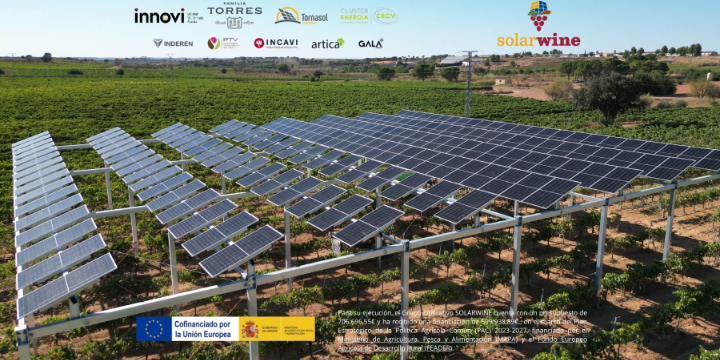
The SOLARWINE Operational Group is moving forward with the development of its two agrivoltaic pilot plants, installed in organic vineyards in Catalonia and Castilla-La Mancha. Following the commissioning of the experimental installations, which cover close to 2,000 m², the project is now in a data collection and monitoring phase. The results will later be analysed to assess how the different agrivoltaic systems perform under real growing conditions.
The project SOLARWINE: New agrivoltaic systems for the smart and sustainable production of grapevines aims to increase the value of agricultural land, promote the dual use of land, and contribute to preserving the landscape and winegrowing culture. It also seeks to make vineyards more resilient to extreme weather events such as heatwaves, recurring droughts and sudden temperature fluctuations.
The initiative offers a practical response to two of the Spanish wine sector’s main challenges: the effects of climate change and rising energy costs. To address them, it combines renewable energy generation with technologies associated with Agriculture 4.0, including advanced sensing, machine learning and artificial intelligence.
A new phase focused on data collection
The vineyards are equipped with an extensive network of connected sensors and monitoring devices. These continuously record a range of variables related to environmental conditions, soil, crops and the operation of the photovoltaic systems. This infrastructure generates time series that make it possible to track how different parameters change throughout the day and over extended periods.
The monitored variables include air temperature and relative humidity, soil moisture and temperature, solar radiation, and temperatures associated with the photovoltaic systems, as well as other parameters needed to characterise conditions in each experimental area.
The data collected is brought together on a digital monitoring platform, where users can view how the variables change over time, consult historical records and compare the performance of different devices and trial areas.
Continuous monitoring will provide a sufficiently representative body of information before the project moves on to its next stage: processing, analysing and interpreting the data collected.
A key part of this phase will be comparing the different configurations in the experimental plots. The data will make it possible to study differences between the control areas and those affected by the various agrivoltaic systems installed.
This will allow the project to examine how the presence of photovoltaic modules affects conditions around the crop, including temperature, humidity, the amount of radiation received and soil conditions.
Monitoring over different periods will also make it possible to track how these variables change over time and identify any patterns associated with the experimental configurations, weather conditions or the specific characteristics of each site.
Data collection is therefore an essential preliminary step in assessing the microclimate created beneath the panels, the plants’ water dynamics, crop development and the energy output of the installations.
Once sufficient information has been collected, the data will be processed and analysed using the tools planned for the project, combining Agriculture 4.0, advanced sensing, machine learning and artificial intelligence technologies.
This analysis will help explore the relationships between environmental conditions, crop performance and energy production, as well as assess parameters linked to vineyard productivity and grape quality.
The ultimate aim is to determine how agrivoltaic systems can help improve the efficiency and sustainability of organic vineyards, and which configurations are best suited to the characteristics of each farm.
The results will also be used to assess the technical and economic feasibility of the solutions tested and build knowledge that could support their adoption by other winegrowing businesses.
The project SOLARWINE: New agrivoltaic systems for the smart and sustainable production of grapevines has a total budget of €706,696.55, of which €599,938.89 has been funded under the 2023–2027 CAP Strategic Plan, co-financed by the Ministry of Agriculture, Fisheries and Food (MAPA) and the European Agricultural Fund for Rural Development (EAFRD).
The project is led by the Catalan Wine Cluster (INNOVI), with participation from Família Torres, Huerto Tornasol and the Valencian Community Energy Cluster (CECV). Supporting organisations also include INDEREN, which provides advanced technological solutions; the Wine Technology Platform (PTV), supporting knowledge transfer across the sector; Gala Media, specialising in wine-sector communications; INCAVI, as a public research body; and Artica+i, the project’s technical office.
Comments