
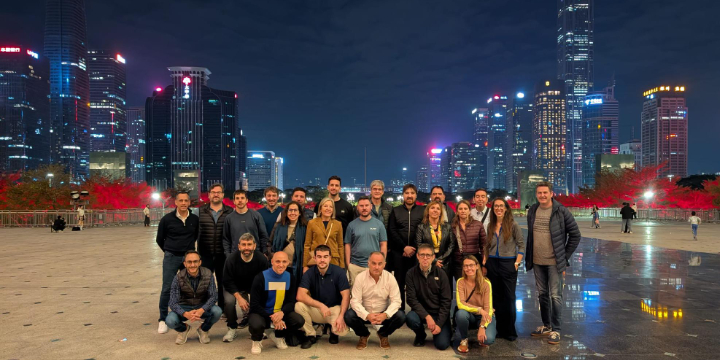
From January 26 to 30, INNOVI has co-organized a business mission to China with the aim of analyzing, from a strategic perspective, how major technological changes are redefining industrial and market models on a global scale, and what implications they may have for the Catalan wine sector.
The first part of the mission took place in Shenzhen, and was shared with the Packaging Cluster, the Foodservice Cluster and the FEMAC Cluster. This initial phase had a clear focus on artificial intelligence, technology and automation, and allowed for first-hand knowledge of business ecosystems where innovation is fully integrated into decision-making, production processes and growth strategies.
During the visits to technology hubs and companies specialized in robotics and advanced solutions, the delegation saw how AI is already part of everyday industrial life, with real applications in fields such as automation, logistics, data analysis and product customization. This reality shows a relevant paradigm shift: technology is not understood as a support, but as a central axis of competitiveness and scalability.
The mission had the participation of the INNOVI Cluster Manager, Eloi Montcada, accompanied by several partners of the cluster —Masia Vallformosa, Juvé & Camps, Lab4Impact, TACTIC / Anawin and the School of Wine Tourism of Catalonia— as well as companies and agents from other clusters of the Catalan agri-food and industrial ecosystem. The trip was part of the RETECH program, with the support of ACCIÓ.
This first immersion in Shenzhen made it possible to delve deeper into the Chinese economic, social and business context, as well as to understand how technology, digitization and innovation are structurally integrated in decision-making, production and marketing.
The visits to technological companies, digital platforms and innovation centers highlighted the central role of artificial intelligence, advanced data management, automation and digital ecosystems in the transformation of the agri-food and wine sectors. These elements have a direct impact on both production efficiency and business models, the relationship with the consumer and the purchase experience.
One of the great values of the mission was the constant exchange between companies, knowledge centers and agents of the sector, which made it possible to contrast visions, detect opportunities for collaboration and analyze which trends can have a real and strategic application in the Catalan context.
This critical look exercise is key to transforming international experience into actionable knowledge, aligned with the needs of the wine industry business and the challenges of competitiveness, sustainability and global positioning.
The second part of the mission took place in Yantai, one of China's main wine-growing territories and the nerve center of both the production and marketing of wine in the country. The stay in the region made it possible to delve deeper into a reality very different from the European one, marked by a strong orientation towards the product and the final consumer, often above the classic criteria of tradition, terroir or industrial efficiency.
One of the most relevant aspects observed was the profile of the products: very sweet drinks, with a low alcohol content, highly flavored and designed for a consumer who is not loyal to traditional wine. In many cases, these are hybrid products, which can have a wine base, but also an apple, beer or other fermented base, with a very blurred border between what in Europe we would consider wine, cider, alcoholic soft drink or functional drink.
Particularly noteworthy is the commitment to products made from red fruits (berries), with very visual and narrative positioning aimed at immediate pleasure. These are products clearly designed to attract new audiences, especially young or occasional consumers, who are more sensitive to taste, design and experience than to origin or the production process.
From an industrial point of view, the visit to some production facilities showed a strong contradiction. These have low levels of sophistication, poorly optimized infrastructures and productive models that would hardly be competitive or sustainable in a European context.
In some cases, projects were identified with very small volumes - around 40,000 bottles per year - associated with high investments, with economic models that would hardly allow a real recovery of the investment in the medium or long term. This reality highlights that, in many projects, the logic is not so much industrial profitability, but the positioning, visibility and symbolic value of the product, often integrated within broader branding, tourism or experience strategies.
In this context, the Changyu theme park is particularly noteworthy, a large-scale wine tourism proposal that combines a museum, immersive experiences, tasting areas and a historical account of wine in China. The complex, well cared for from an aesthetic and experiential point of view, exemplifies how the Chinese sector understands wine not only as an agri-food product, but as a cultural, recreational and touristic element, with a clear desire to generate memorable experiences for the visitor.
For the Catalan wine sector, Yantai offers a clear reading: not so much as a model to be replicated, but as a laboratory of ideas, especially in terms of product development, consumer adaptation, narrative and experience.
From INNOVI, this mission is conceived as a strategic tool to anticipate trends, generate a shared vision and open new opportunities for the cluster's partners. The future of the sector is built with a global view, collaboration and shared innovation.
Comments